
Daffy Duck: The Marvin Missions story
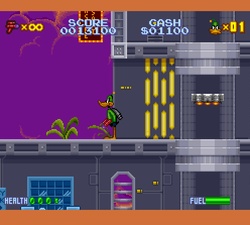
Daffy Duck had a set role in our childhoods: the eternal braggart who dives headfirst into trouble and still squeezes in a couple of snarky one-liners. So when his spacefaring alter ego—Duck Dodgers—landed on the Super Nintendo, everything clicked: a send-up of space operas, a green-eyed Marvin the Martian with those porthole peepers, a laser blaster, and a jetpack. That’s how we got the game known alternately as Daffy Duck: The Marvin Missions, “Daffy Duck: Marvin Missions,” or simply “the Daffy Duck game” set in the 24½th century. No need to pitch it hard: Looney Tunes sold itself, and a cartridge with that unmistakable duck bill did the rest.
From cartoon to cartridge
The roots trace back to the classic short Duck Dodgers in the 24½th Century—the one where Daffy plays a space hero and Marvin plans to vaporize Earth to make room for a construction site. In the 16-bit era, studios chased brands not just for a name on the box, but for personality: slapstick gags, caricatured scale, the chance to turn every frame into a punchline. On SNES it played like a straight run-and-gun platformer with dashes, jumps, a jetpack, and a blaster—delivered in full-on Duck Dodgers fashion: absurdity, self-parody, and that brassy fanfare like someone’s about to say, “That’s all, folks!”
Having the Looney Tunes license wasn’t just about character portraits—it was about nailing cartoon timing. When Daffy struts on-screen, strikes the superhero pose, and rockets off on his jetpack under twinkling stars, you feel it: the devs weren’t just “drawing a duck,” they were bottling Warner Bros. energy and cramming it into a cart. It worked—even the menus and credits played like the TV bumpers we grew up with. Not a checkbox license, but a lively space romp with a trademark smirk.
How it reached players
In the US and Europe, Daffy Duck: The Marvin Missions hit in the early-to-mid ’90s and even zipped onto Game Boy. Official localizations were rare in some regions, but a different kind of magic carried it: console rentals, video-store displays, loud box art, and bootleg carts without manuals, where the title could change from batch to batch. Hence the wandering names—“Daffy Duck: Marvin Missions,” “The Marvin Missions,” sometimes just “Duck Dodgers.” But no one got confused: the first screen flashed that familiar bill, then Marvin the Martian, and your heart did that classic 16‑bit ding.
Kids who caught Looney Tunes on TV loved it, and so did players who’d already burned through “serious” space sagas. Here, space was a toybox—Martian base platforms, glowing panels, mechanical bosses, and goofy traps. The SNES art leaned comic-book: chunky sprites, generous animation, with “boom” and “pow” practically reading off the screen. For many, it clicked instantly—the kind of arcade that turned your living room into a mini cartoon, with your pad cueing the gags.
Why it stuck
The secret’s simple: The Marvin Missions is Looney Tunes without compromise, wrapped as a platformer. The blaster snaps like a party popper, the jetpack hisses like an aerosol, and Daffy is all attitude—even when he takes it on the beak. Every locale nods to favorite spoofs: a spaceport with twitchy guards, a dusty Mars with “touchy” rocks, Marvin’s labs where yet another “uhhh… catastrophic experiment” is brewing. Yes, it’s a run-and-gun in a cartoony skin, but that skin is everything—without it, just another platformer; with it, a retro time capsule that smells like VHS clamshells and Saturday mornings.
The ’90s were swamped with licensed games, but Daffy Duck: The Marvin Missions lingers as Duck Dodgers’ SNES calling card. Not the most common shelf piece, yet recognizable from half a sprite: the attitude sets the tempo, the soundtrack winks at the heroic march, and showdowns with Marvin play out like sketch-comedy bits of who-outsmarts-whom. And on the edge of the frame, that’s us: pick the moment, hop, hover on the jetpack for a heartbeat, loose a laser burst—like dropping the final beat of a punchline.
How it spread worldwide
Warner Bros. licensing meant broad distribution—from the US to Europe—while gray imports pushed it deep into Eastern Europe. Where manuals didn’t make it, fans named it from memory: “the Daffy Duck game,” “Dodgers vs. Marvin,” “The Marvin Missions.” Carts bounced from clubs to markets to suitcases—that’s how our own 16-bit chronicle was written, the one we keep reminiscing about in /history/. Over time, the cartridges settled with collectors, and the title stuck the way kids heard it back then: no translation debates, just a grin.
Years later, the Duck Dodgers brand got a second wind as a TV series, but for many, this cartridge was the first interactive handshake with the “space hero.” That’s where the warmth comes from: you’re not just watching the gag—you’re performing it. Sure, it’s an SNES platformer at heart, but the feel isn’t game math; it’s cartoon humor thumping under your thumbs. When the peppy theme kicks in and Daffy winds up for another stunt, it’s obvious why The Marvin Missions set up camp in the memories of players raised on Looney Tunes.
If you want to dig into the nuts and bolts—how the jetpack shifts the pace and the blaster sets the rhythm—head to /gameplay/. The story here is about a time when TV icons suddenly popped into your living room on a little gray cartridge, and a single button press was enough to blast off to the 24½th century with the cockiest hero in the galaxy.